Position sizing: decide the risk before the entry
How much to risk comes before where to enter. This article shows how a fixed-percentage rule turns a stop distance into a position size, with a worked example.
Introduction
Many traders choose a position size by feel, then place a stop wherever it keeps the loss “small enough”. Position sizing reverses the order: first decide how much of the account a single idea may cost, then let the stop distance decide the size.
Framework
A fixed-percentage rule has three inputs:
- Account equity: the money in the trading account.
- Risk per trade: the share of equity you accept to lose if the stop is hit, for example 1%.
- Stop distance: how far the stop is from the entry, in pips or points, set by the chart, not by the size.
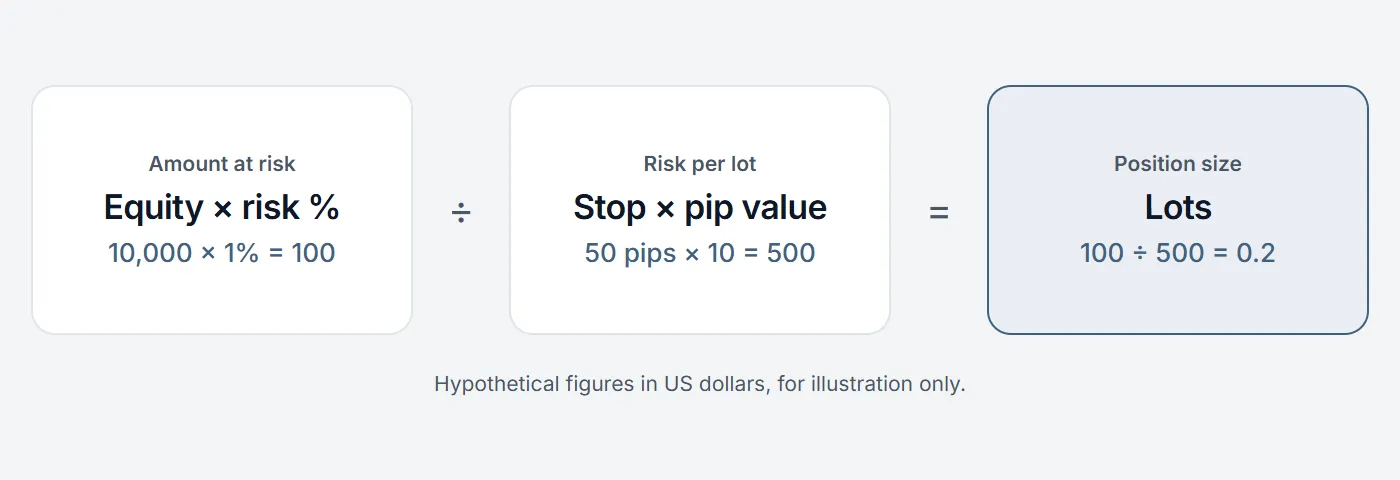
The size then follows: size = (equity × risk per trade) ÷ (stop distance × value per pip for one lot).
Example or application
Hypothetical example, for illustration only; not a real trade. Equity is 10,000 US dollars and the rule is 1% per trade, so 100 dollars is at risk. The chart puts the stop 50 pips from the entry on EUR/USD, where one standard lot is worth about 10 dollars per pip.
Size = 100 ÷ (50 × 10) = 0.2 lots.
If the stop must be 100 pips away instead, the size halves to 0.1 lots. The money at risk stays the same; only the size changes.
Limitations and risk
- Stops are not guaranteed. Gaps and fast markets can fill a stop at a worse price, so the real loss can be larger.
- Pip values change with the instrument, the account currency and exchange rates. Check them on your platform.
- Several open trades add up. Five positions at 1% each is 5% at risk if they move together.
- Leverage magnifies losses as well as gains. A sizing rule limits risk; it does not remove it.
Sources
- U.S. Securities and Exchange Commission, Investor.gov: Margin account (checked 2026-10-26).
- Financial Conduct Authority, Contract for differences (checked 2026-10-26).
Educational content only; not personalised investment advice.